
QLME 3.0: The Evolution of Qur'anic Language Learning with Guided AI
Most of us learned to read the Qur'an before we learned to listen to it. We were taught the letters, the rules of tajwid, and the rhythm of recitation — all of them gifts. But somewhere along the way a quiet question went unanswered: what is this verse actually saying to me?
QLME — Qur'anic Language Made Easy — exists to answer that question. This article explains the whole methodology: where it came from, what it teaches, what "Guided AI" really means in QLME 3.0, and who it is for. It is not a sales page. Read it, and decide for yourself whether this is the next step in your relationship with the Qur'an.
Why So Many Still Struggle to Understand the Qur'an
There is a difference between reading and understanding, and it is bigger than most people expect.
Reading is a skill of the tongue. It is trained through repetition, correction, and time with a teacher. Understanding is a skill of the mind and heart. It requires knowing what the words mean, how they are arranged, and why one word was chosen over another that seems similar.
A Muslim can complete the Qur'an many times and still not know what any single verse asked of them. This is not a criticism — it is simply the natural result of a learning path that ended at recitation. The Qur'an was revealed as guidance, and guidance is only guidance when it is understood.
Understanding is also what makes tadabbur possible. Tadabbur is not an emotional performance; it is reflection built on comprehension. You cannot reflect deeply on a sentence you cannot follow. Once the meaning is present, reflection follows almost by itself — and reflection is what connects knowledge to action. Knowledge that never reaches action stays as information. Knowledge that reaches the heart changes how a person prays, speaks, works, and treats their family.
That chain — reading, understanding, reflection, action — is the whole design of QLME.

Reading brings us to the page. Understanding brings the page to us.
Pause here. Ask yourself one honest question: when was the last time a verse you recited changed something you did that same day?
The History of QLME: Three Eras
QLME did not arrive fully formed. It has been shaped by more than twenty batches of adult learners in Singapore, and it has passed through three distinct eras.
QLME 1.0 — Building the Foundation
The first era was classical and unhurried. Students met their teacher in person and worked through the building blocks of Qur'anic Arabic: the three word classes, basic grammar, and sentence patterns that repeat across the mushaf.
The insight behind QLME 1.0 was simple but important: adults do not need to become Arabic scholars to understand the Qur'an. They need the high-frequency vocabulary and the recurring structures. Teach those well, and a large proportion of the Qur'an becomes readable with meaning.
This era established the discipline that everything else rests on. There are no shortcuts around it.
QLME 2.0 — The Digital Shift
The second era was forced open by circumstance. During the pandemic, classes moved online, and what began as a compromise turned into an improvement.
Recordings meant a student who missed a session was no longer left behind. Working adults could revisit a difficult explanation at midnight. Learners outside Singapore could join. Hybrid delivery — physical sessions for those who benefit from being in the room, online sessions for those whose weeks do not allow it — became permanent, not temporary.
QLME 2.0 taught us that flexibility is not a lowering of standards. It is what allows a serious adult learner to stay in a serious programme for the length of time real learning takes.
QLME 3.0 — Guided AI
The third era responds to a change no Qur'an teacher can ignore. Students already use AI. They ask chatbots about verses, about grammar, about rulings. Some of what they receive is useful. Some is confidently wrong.
QLME 3.0 does not pretend this is not happening, and it does not hand the classroom over to a machine. It teaches students to use AI responsibly, under supervision, as a research assistant that accelerates study while the teacher remains the authority.
Why use AI at all? Because certain parts of study that once consumed hours — assembling a word's occurrences, comparing translations, organising notes, drafting a presentation — can now be done in minutes, leaving more time for the part that actually matters: reflection with a teacher.
Why does AI not replace the teacher? Because AI has no taqwa, no sanad, no responsibility before Allah for what it says, and no ability to know that a particular student has misunderstood something in a way that will matter later. It produces fluent text. A teacher produces understanding.
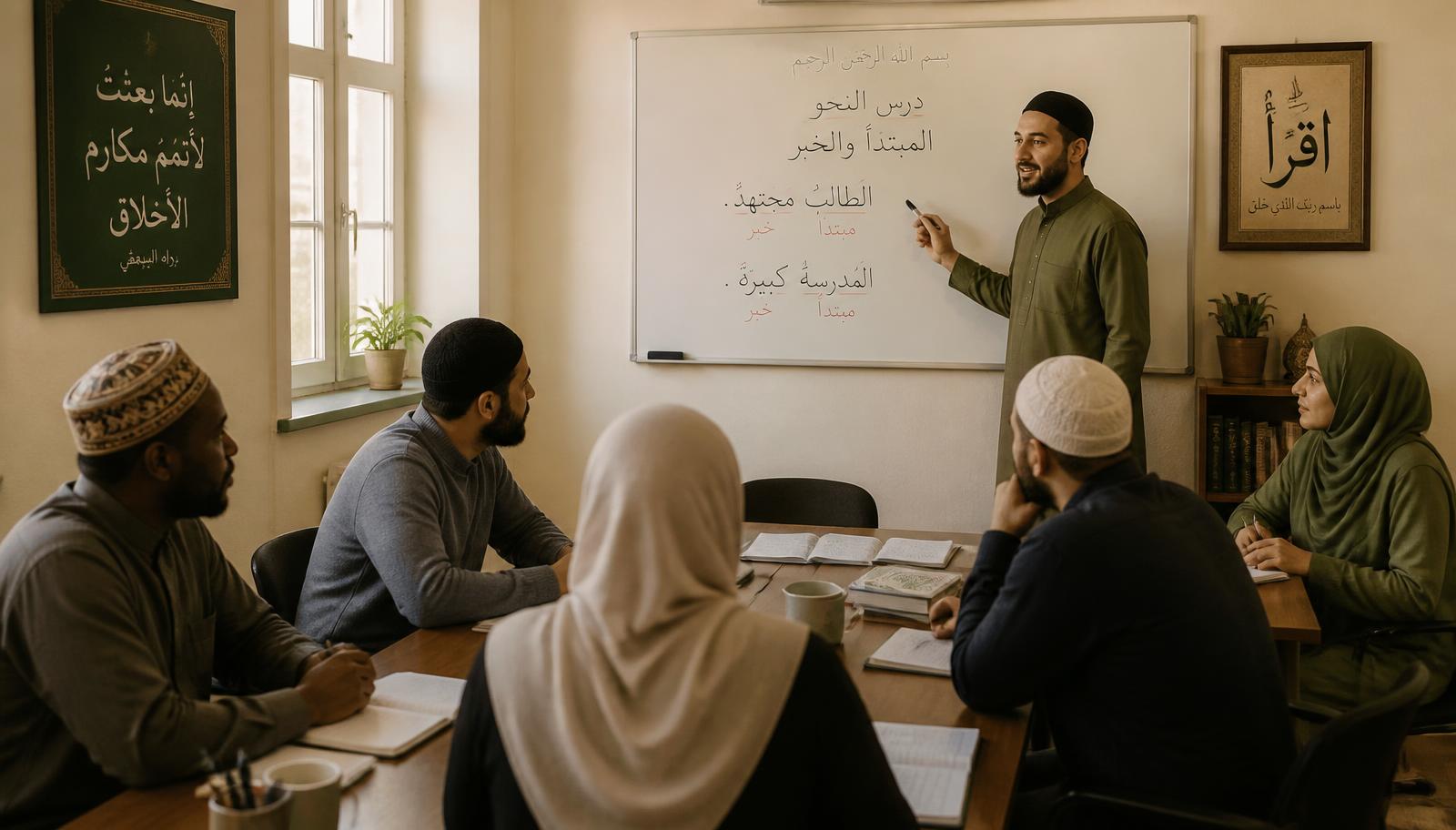
QLME is built for working adults — not for specialists.
Why the Language of the Qur'an Matters
Every word in the Qur'an was chosen. That is not a poetic statement; it is a theological one. When a text is revealed, word choice is deliberate, and meaning lives inside that choice.
Consider what translation cannot carry. Arabic distinguishes shades that English or Malay collapse into one word. A verb form can indicate that an action is continuous rather than completed. Word order can place emphasis where a translation must place it flatly. A definite article can turn a general statement into a specific one.
Then there is balaghah — the eloquence of the Qur'an. A rhetorical question that is not really a question. A pause that carries weight. A repetition that is not redundancy but insistence. These are not decorations on top of the message; in the Qur'an, they are part of the message.
None of this means translations are worthless. Translations are a mercy and a necessary starting point. But a translation is one scholar's understanding rendered into another language, and it can only carry so much. The moment you recognise even a few dozen Qur'anic words directly, the recitation stops being a melody and becomes a conversation.
That is the modest, achievable goal of QLME: not fluency in Arabic, but direct contact with the words of the Qur'an.
What "Guided AI" Actually Means
This is the section that most needs care, so let us be exact.
AI is not a teacher. It has not studied under anyone, it holds no chain of transmission, and it cannot be held accountable.
AI is not a source of religious authority. It does not issue rulings. It does not settle differences between scholars. Anything it says about the deen is a claim to be verified, never a verdict to be accepted.
AI is a learning tool. Used well, it is an assistant that helps a student organise, search, compare, and draft — faster than they could alone.
The tools we work with
ChatGPT and Claude are used for language work: explaining a grammatical structure, comparing how a root is used in different verses, or turning rough notes into a clear summary.
Google NotebookLM is different in an important way — it answers only from documents you supply. Give it verified tafsir material and it becomes a search engine over trusted sources rather than an open-ended generator. For Qur'anic study, this constraint is a feature.
AI search tools help locate sources quickly, but what they surface must still be opened and read. A citation is not a proof until you have checked it.
The discipline that makes it safe
Cross-checking is non-negotiable. Anything an AI states about a verse is checked against recognised tafsir and against the teacher.
Trusted references come first, not last. The student's library — the mushaf, tafsir, dictionaries — is the authority. AI is scaffolding around it.
Prompt engineering is taught as a real skill, because a vague question produces a vague answer, and a vague answer about the Qur'an is worse than no answer.
Teacher guidance closes the loop. Student research is brought back to the class, where the teacher corrects, refines, and where necessary rejects it.
And the most important principle of all: AI is only useful to a student who already has foundations. Without them, a student cannot tell a sound answer from a fluent mistake. This is precisely why QLME teaches the language first and introduces AI second. The order is not accidental.
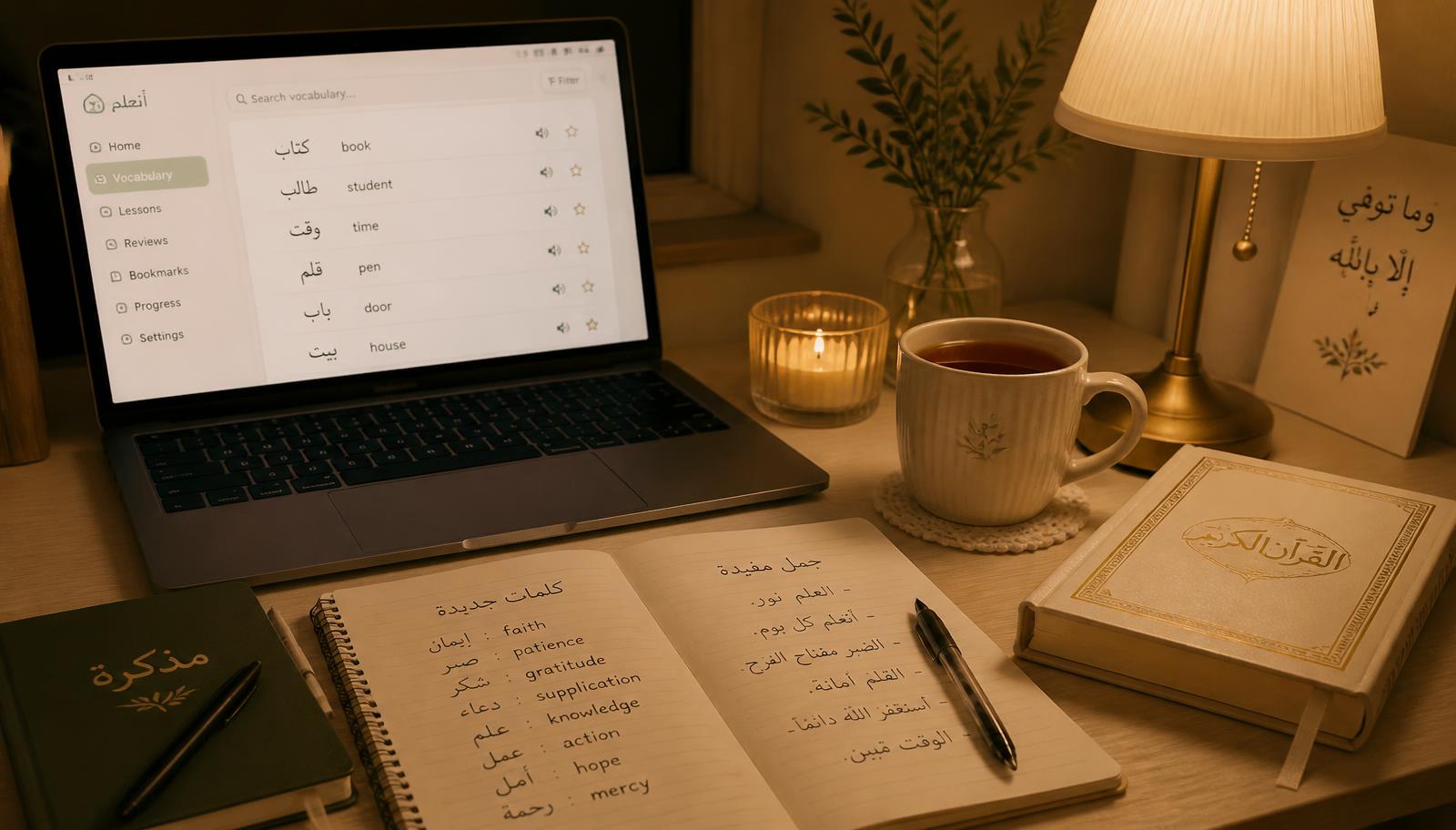
Guided AI belongs on the study desk — beside the notes, never in place of the teacher.
A line we do not cross. AI may help you rehearse a question. It may never issue a ruling, and it may never replace the correction of a qualified teacher.
The QLME 3.0 Learning Framework
The programme follows one path, deliberately sequenced:
Learn the language of the Qur'an → Use guided AI → Research → Verification → Tadabbur → Muhasabah → Action
Learn the language of the Qur'an. Isim, fi'il, harf; the grammar that governs them; the sentence patterns that repeat. This is the foundation, and no stage after it works without it.
Use guided AI. Once you can read a verse structurally, AI becomes genuinely useful. You ask better questions and you can evaluate the answers.
Research. The student investigates: how this root is used elsewhere, what the classical commentaries say, what the context of revelation adds. This is real work, and AI shortens the mechanical parts of it.
Verification. Everything gathered is checked — against tafsir, against the teacher, against classmates in discussion. Errors are caught here, and this stage is never skipped.
Tadabbur. With a verified understanding in hand, the student slows down and reflects. What is Allah saying? Why here? What does this ask of me?
Muhasabah. Reflection turns inward. Where does my life contradict what I have just understood? This is uncomfortable, and it is the point.
Action. Understanding must land somewhere: in prayer that is more present, in speech that is more careful, in a habit changed. Knowledge that does not reach action has not completed its journey.
What You Will Learn
The language of the Qur'an — high-frequency vocabulary and the structures that recur throughout the mushaf.
Isim (nouns) — recognising them, their cases, and what those endings signal about meaning.
Fi'il (verbs) — tense, form, and how a verb pattern shifts meaning.
Harf (particles) — the small words that carry enormous weight in a sentence.
Nahu (syntax) — how words combine into meaningful sentences, and how a change in order changes emphasis.
Sarf (morphology) — how roots generate families of related words, so one root learned unlocks many words.
Sentence structure — reading a verse as a structure rather than a string of separate words.
The beauty of the language — an introduction to balaghah, so students begin to notice eloquence rather than read past it.
Responsible AI use — practical, supervised work with the tools described above.
Tadabbur — guided reflection sessions on both familiar and unfamiliar passages.
Practice — regular exercises, because language is not learned by listening alone.
Presentation — students present their own study to the class. Nothing exposes a gap in understanding, or confirms real learning, like having to explain it to others.
Ten minutes a day, honestly kept, will take you further than three hours once a month.
Who Is This For?
Complete beginners. If you have never studied Arabic, you are the person QLME was designed for. The programme assumes no prior grammar.
Working adults. Sessions are structured around real schedules, with recordings for the weeks that get away from you. Consistency matters more than intensity.
Retirees. Many of our most committed learners are past sixty. Adults understand rules faster than children do, and this is a subject built on rules.
Parents. Parents often join wanting to answer their children's questions honestly, and end up finding that the Qur'an is answering their own.
Qur'an teachers. Teachers of recitation who want to add meaning to their classes gain both content and a method they can adapt.
Da'wah workers. Anyone who speaks about Islam publicly benefits from working with the text directly rather than through second-hand summaries.
Students. Younger learners who want the language foundation their formal education did not provide.
Answering the Common Objections
"I don't know Arabic." That is the assumption we start from. QLME begins before grammar and builds gradually. Students who have never seen an Arabic textbook complete the programme every batch.
"I'm busy with work." So are most of our students. The structure is one session per week plus short practice. Sessions are recorded. A busy adult who is consistent will outperform a free adult who is not.
"I can only attend online." That is supported. Online students receive the same curriculum, the same teacher, and the same access to materials.
"I'm too old for this." Adults learn language rules faster than children — children memorise outcomes, adults understand reasons, and reasons transfer to every new word. Some of our strongest learners started in their sixties and seventies.
"Isn't AI often wrong?" Yes, and we say so openly. That is exactly why it is guided. AI never has the final word in QLME; the teacher and verified references do. Students are taught how AI fails so they can recognise it when it happens.
"Why learn the language when translations exist?" Use translations — they are valuable. But a translation is an interpretation. Knowing even a little of the original lets you meet the words directly, and that changes the experience of every prayer.
"Does AI replace the teacher?" No. AI accelerates research. Teachers build understanding, correct errors, and carry the responsibility of transmitting sacred knowledge. That role is not transferable to software.
"Is the programme too difficult?" It is demanding but not overwhelming. Modules are sequenced, each building on the last, with a teacher present throughout. Students are not left alone with a textbook.
About Ustaz Zulkiflee Bachik
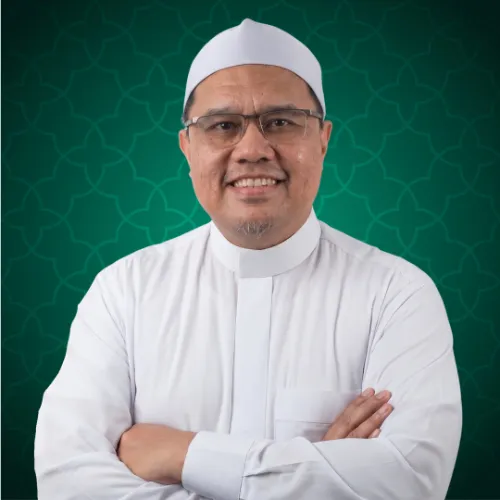
Ustaz Zulkiflee Bachik, Founder and Director of AtTartil QI.
QLME was developed by Ustaz Zulkiflee Bachik, founder and Managing Director of AtTartil Quranic Institute.
He came up tops in the Imam Course organised by MUIS in the early 1990s and excelled in the Tahfizul Quran programme. He holds a Qur'an recitation certification with sanad and tajwid from Ma'had IQRA Egypt, awarded by his teachers. He was a top student at Kolej Sultan Ismail Petra Nilam Puri, majoring in Arabic, and holds a Diploma in Islamic Studies from Kolej Universiti Malaysia. He graduated top of his cohort in Al-Ahwal Al-Syakhsiah and was named valedictorian; his thesis went on to win an award from Universiti Sumatera Utara, Medan.
He has presented his Fahami Bacaan Dalam Solat methodology across several Malaysian states — Kelantan, Kuala Lumpur, Sarawak — and at the Embassy of the Republic of Indonesia. In 2012 and 2014 he led AtTartil's participation as a partner in MUIS' Ramadan Programme.
Among colleagues and students he is known for humility and for preferring to stay out of the limelight. His interest in AI-assisted Qur'anic learning is a continuation of a habit that has defined his teaching for decades: constantly researching and refining how the Qur'an can be taught more effectively. QLME 3.0 is that habit meeting a new set of tools.
His conviction anchors the whole institute: one can accumulate every credential in Qur'anic study and still need to ask why our Lord revealed the Qur'an in the first place.
Why This Batch Is Different
Each batch refines the programme, and the current one carries the most significant update since QLME went hybrid.
Guided AI is now part of the curriculum rather than an optional extra. Students are trained in the tools, the risks, and the verification discipline.
The methodology has been updated so that language study, research, and reflection are sequenced deliberately rather than treated as separate subjects.
A structured research workflow gives students a repeatable process they can use long after the programme ends.
Digital resources — recordings, materials, and a private learning hub — mean the classroom is available between sessions.
Student presentations have a larger role, because explaining your own study is the fastest way to discover what you truly understand.
And reflection and tadabbur remain the destination. Every new tool in QLME 3.0 exists to protect time for that, not to replace it.
Closing
AtTartil Quranic Institute exists for one purpose: Where Qur'anic Knowledge Transforms Lives.
The aim of QLME has never been to complete a syllabus. Completion certificates are pleasant; they change nothing on their own. The aim is that Qur'anic knowledge reshapes how a person understands their Lord, how they pray, how they carry themselves, and how they live an ordinary Tuesday.
That is slow work. It cannot be rushed by technology, and QLME 3.0 does not claim otherwise. What guided AI offers is time — time taken back from the mechanical parts of study and returned to reflection, discussion, and the company of a teacher.
If you have been reading the Qur'an for years and quietly wondering what it is saying, that wondering is a good sign. It is the beginning of tadabbur.
You are welcome to join us.
Ready to move from reading to understanding the Qur'an?
Explore QLMERelated Articles
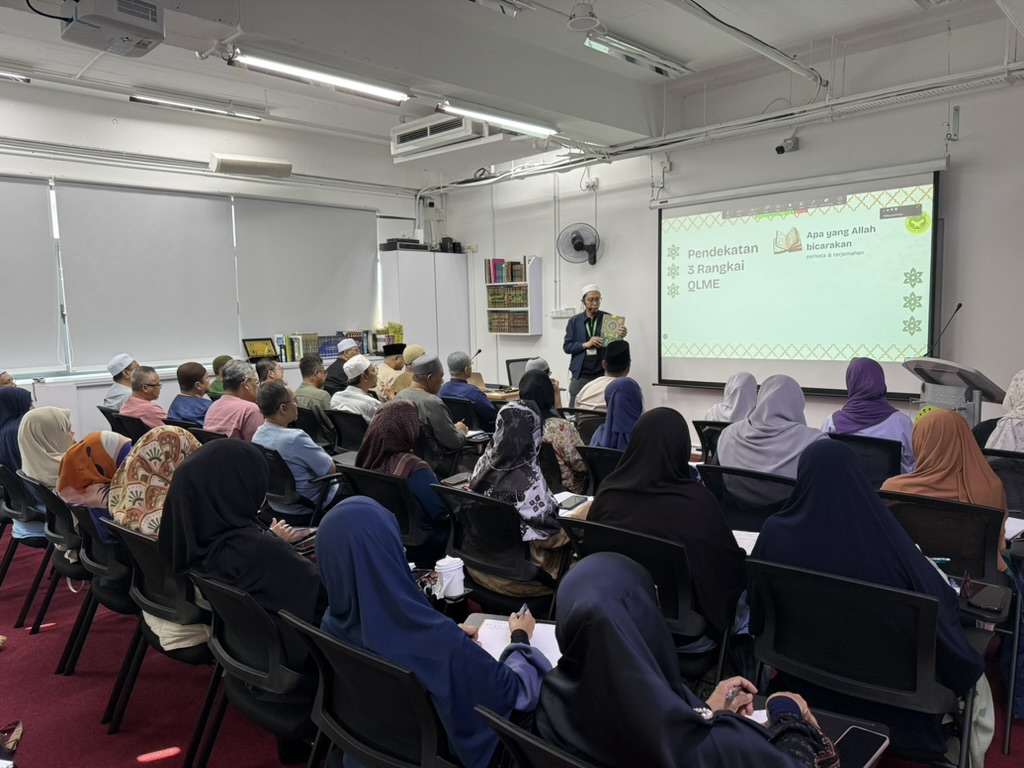
QLME 3.0 Batch 23 Begins: From Reading the Qur’an to Understanding Its Language
QLME 3.0 Batch 23 begins with a full house of physical and online learners, taking the next step from reading the Qur’an to understanding its language with sincerity and istiqamah.
Read More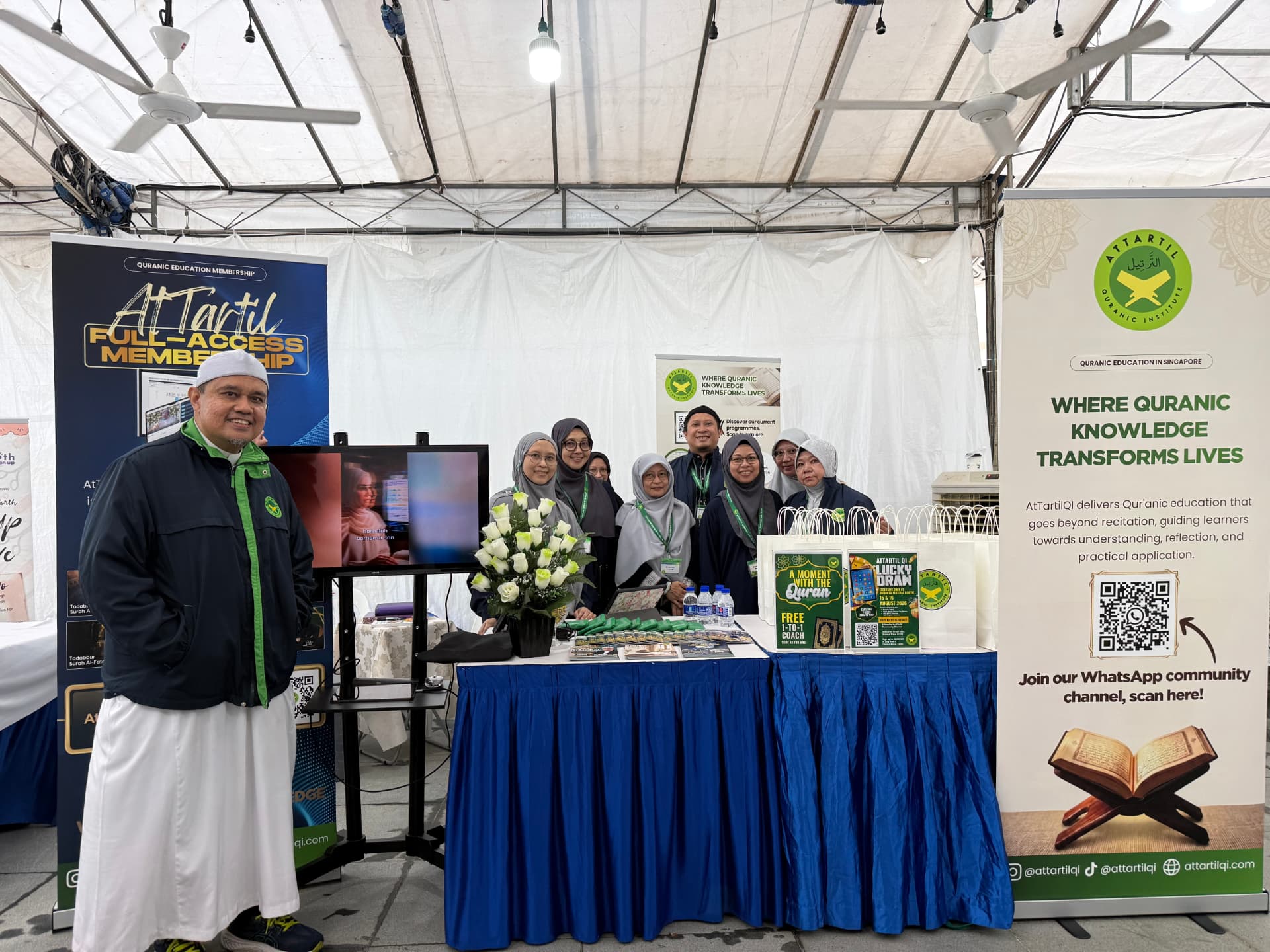
Two Days, One Mission: Bringing People Closer to the Qur'an
AtTartil QI spent two days at Quran Festival 2026 at Masjid Sultan Singapore, meeting visitors from Africa, France, the United States, Indonesia, Malaysia, and Japan, and welcoming more than 50 participants to 'A Moment With Al‑Quran'.
Read More
Am I Too Old to Learn to Read the Qur'an?
It is the question we hear most often from adults in Singapore — usually said quietly, and usually with some embarrassment. Here is the honest answer, from teachers who have taught hundreds of adult beginners.
Read More